Introduction
Most AI-generated portraits fail for a simple reason they try too hard.
Perfect lighting, flawless skin, centered framing… everything looks polished, but nothing feels real. And that’s exactly where realism breaks.
The goal here isn’t to create “beautiful” images. It’s to recreate moments that feel like they just happened slightly messy, unintentionally framed, and grounded in everyday environments.
Using Google Gemini, the focus shifts from perfection to believability: natural posture, imperfect lighting, small environmental details, and most importantly, restraint.
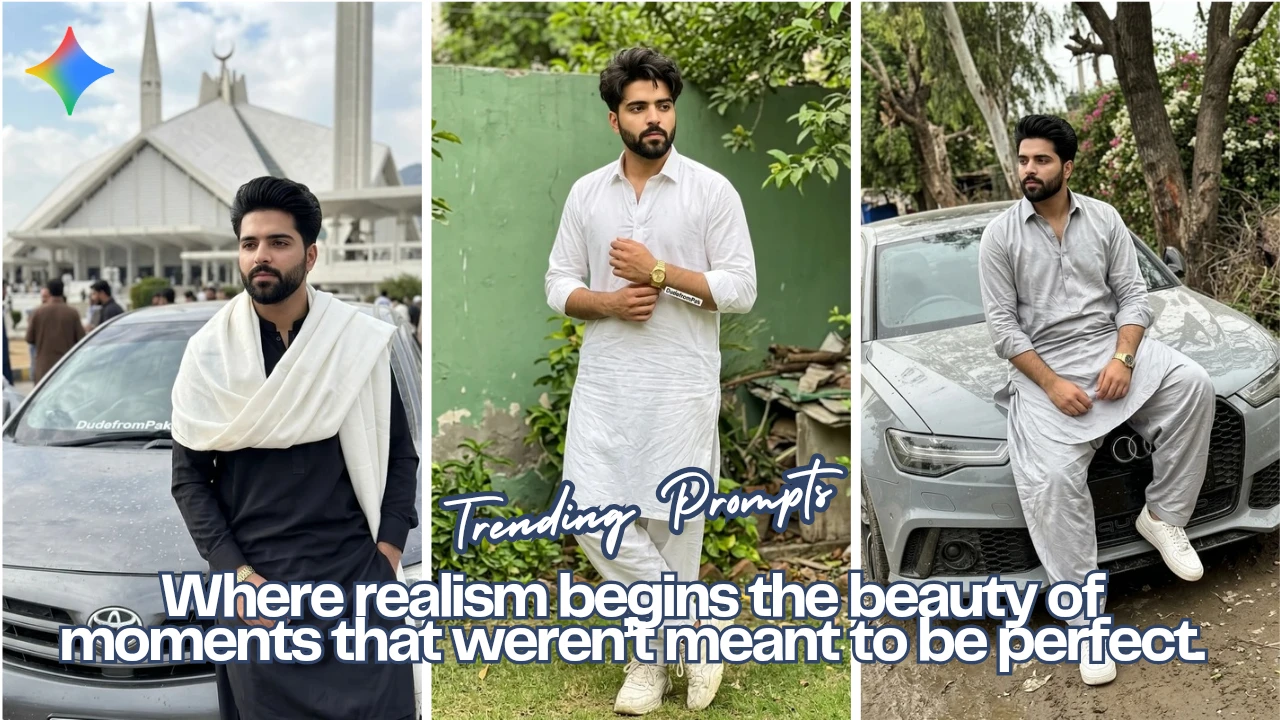
Below are three different scenes built around that idea. Each one uses controlled imperfection to mimic how real iPhone photos actually look in everyday life.
Scene 1: Roadside Pause
Prompt Used:
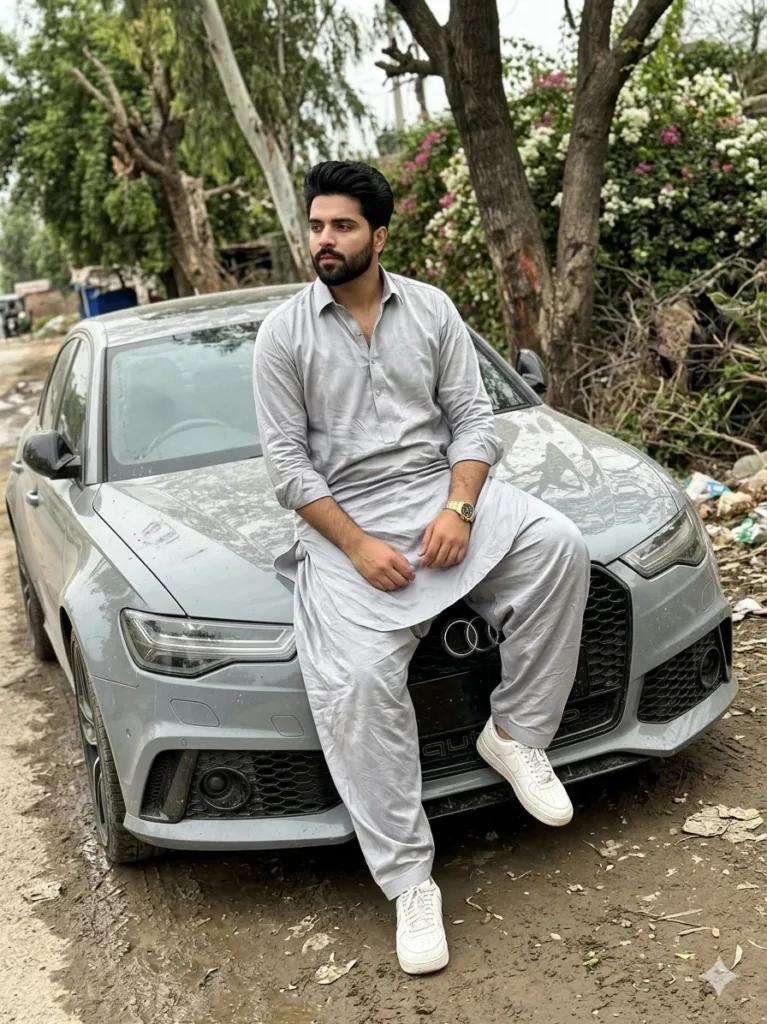
Ultra-realistic accidental iPhone photo of a young South Asian man (use uploaded face exactly), sitting casually on the hood of a grey Audi RS6 (slightly dusty, not showroom clean) parked on a muddy roadside in Pakistan.
Wearing a loose silver-grey shalwar kameez with natural fabric folds, slightly creased, paired with simple white sneakers and a gold wristwatch, no glasses. Relaxed unposed posture, one leg hanging, slight slouch, looking away mid-thought.
Shot vertical, close low angle, imperfect framing, slight tilt, mild motion blur, uneven daylight, real skin texture, no retouching.
Background: rough roadside, small trees with white/pink flowers, scattered plants, natural clutter.
–ar 9:16 –style raw –v 6 –q 2 –chaos 10
What makes it work:
This scene leans heavily on contrast. A high-end car placed in an unpolished roadside setting instantly breaks the “AI perfection” pattern. The slight dust on the car and the uneven ground matter more than the subject itself they anchor the image in reality.
The low angle and imperfect tilt mimic how someone casually pulls out their phone without thinking too much. It doesn’t feel composed, and that’s exactly the point.
Scene 2: Between Movement and Stillness
Prompt Used:
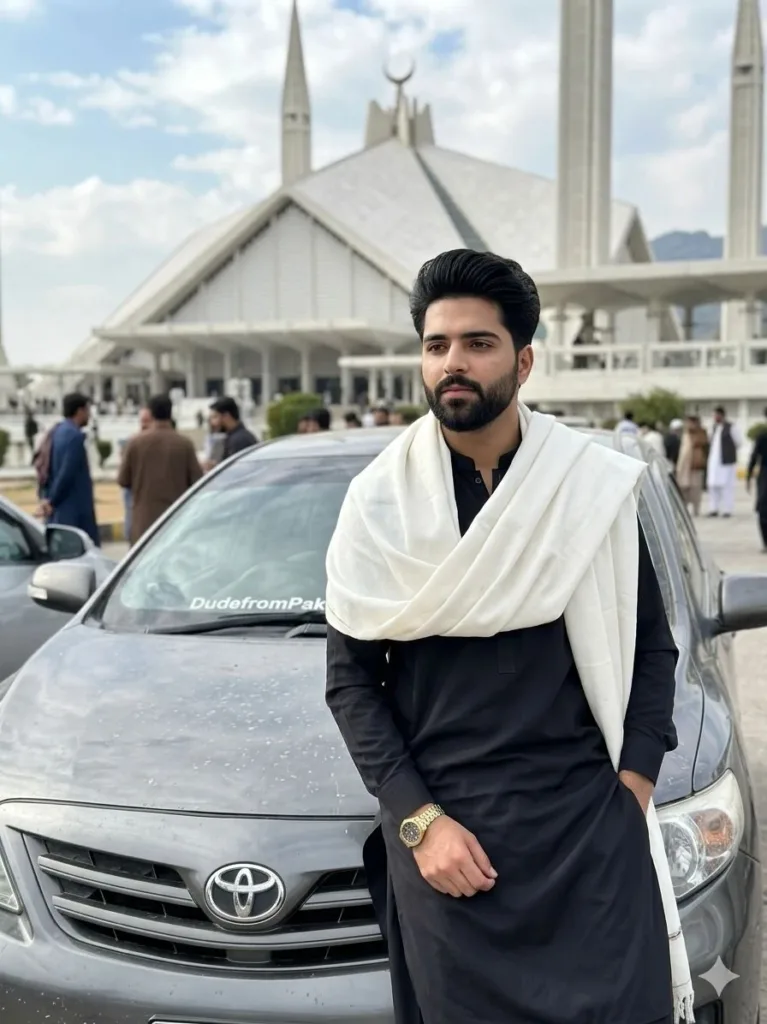
Ultra-realistic accidental iPhone photo of a young South Asian man (use uploaded face exactly), wearing black shalwar kameez with natural fabric folds, a slightly creased white shawl, gold wristwatch, no glasses. Leaning casually on the front side (hood/bonnet) of a slightly dusty grey Toyota sedan (small “DudefromPak” sticker, subtle).
Unposed posture one hip resting on the hood, one hand in pocket, other loosely placed on the car, relaxed stance, natural neutral expression, looking slightly away mid-moment.
Shot vertical, slight low angle, handheld, imperfect framing, slight tilt, mild motion blur, uneven natural daylight, soft shadows, real skin texture, no retouching.
Background: Faisal Mosque visible but not perfectly centered, normal visitors faintly present, partly cloudy sky.
–ar 9:16 –style raw –v 6 –q 2 –chaos 8
What makes it work:
The key decision here is not centering the Faisal Mosque. Most AI images would highlight it perfectly, but real photos rarely do.
The subject’s posture feels transitional like he just paused for a second rather than posing. The slight motion blur and uneven daylight reinforce that this wasn’t staged.
Even the small sticker detail on the car adds a layer of authenticity. It’s subtle, but details like this make the image feel lived-in rather than generated.
Scene 3: Everyday Stillness
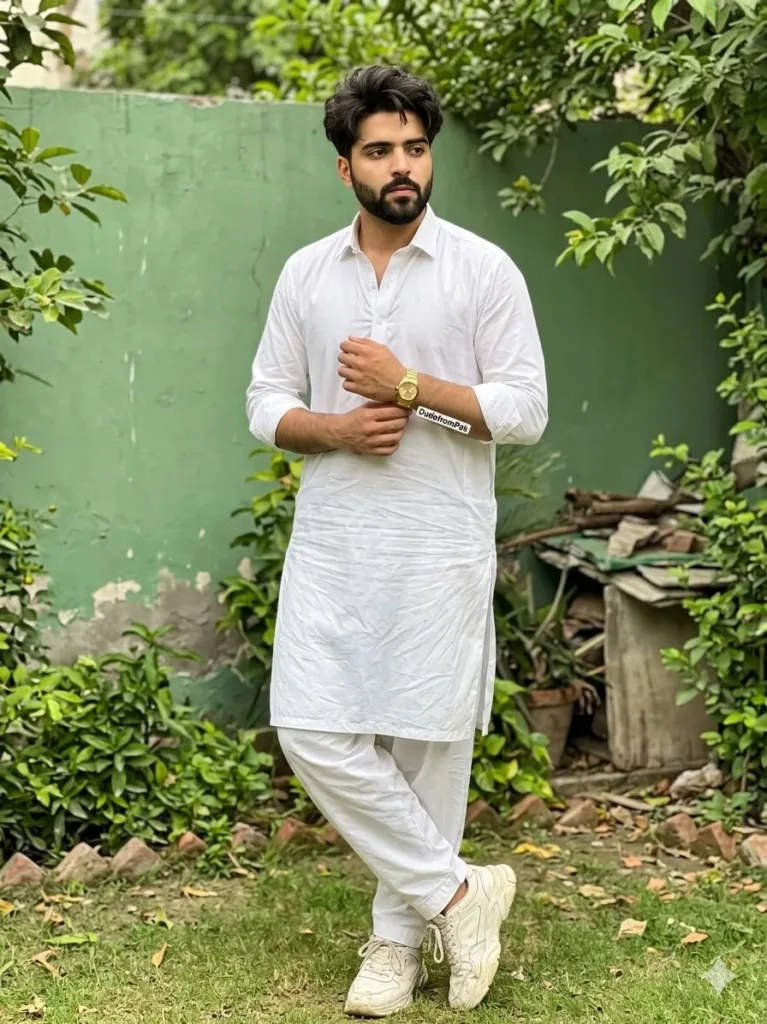
Prompt Used:
Ultra-realistic accidental iPhone photo of a young South Asian man (use uploaded face exactly), standing casually near a slightly worn green wall in a local Pakistani garden. He has short voluminise hair, trimmed beard and chiseled jawline. Wearing a simple white shalwar kameez with natural fabric folds, gold wristwatch, no glasses, paired with slightly used chunky white sneakers.
Unposed stance one hand touching his wrist watch, slight slouch, messy fringe hair, neutral expression looking off-camera.
Shot vertical, eye-level handheld, imperfect framing (slightly cropped), mild motion blur, uneven natural daylight, soft shadows, slight highlight overexposure, real skin texture, no retouching.
Background: dense greenery, imperfect wall texture, natural clutter.
–ar 9:16 –style raw –v 6 –q 2 –chaos 9
What makes it work:
This scene is the most minimal, which makes it harder to execute well.
There’s no luxury element or landmark to rely on only texture and subtle human behavior. The slightly worn wall, uneven greenery, and overexposed highlights create a familiar visual language.
The gesture of adjusting a wristwatch is small, but it gives the subject a reason to exist in the frame. Without that, the image would feel empty.
Conclusion
Realism in AI images doesn’t come from adding more detail it comes from removing control.
Perfect symmetry, balanced lighting, and clean environments are easy for AI. What’s harder is recreating the randomness of real life: awkward angles, imperfect timing, and environments that don’t try to impress.
These prompts work because they introduce friction dust, motion blur, uneven light, off-center framing. Individually, these might look like flaws. Together, they create something believable.
If you’re using Google Gemini for photorealistic results, the shift is simple but uncomfortable:
stop trying to make the image look good, and start making it feel real.
Try Google Gemini Here:
This blog post and AI prompts were created by Shahbaz Ahmad.
Follow me on TikTok @Dudefrompak for more ready-to-use prompts.

📢 Join Our WhatsApp Channel
Get daily AI photo editing prompts, tools, and tips directly on your phone.
Join Now on WhatsApp 🚀