
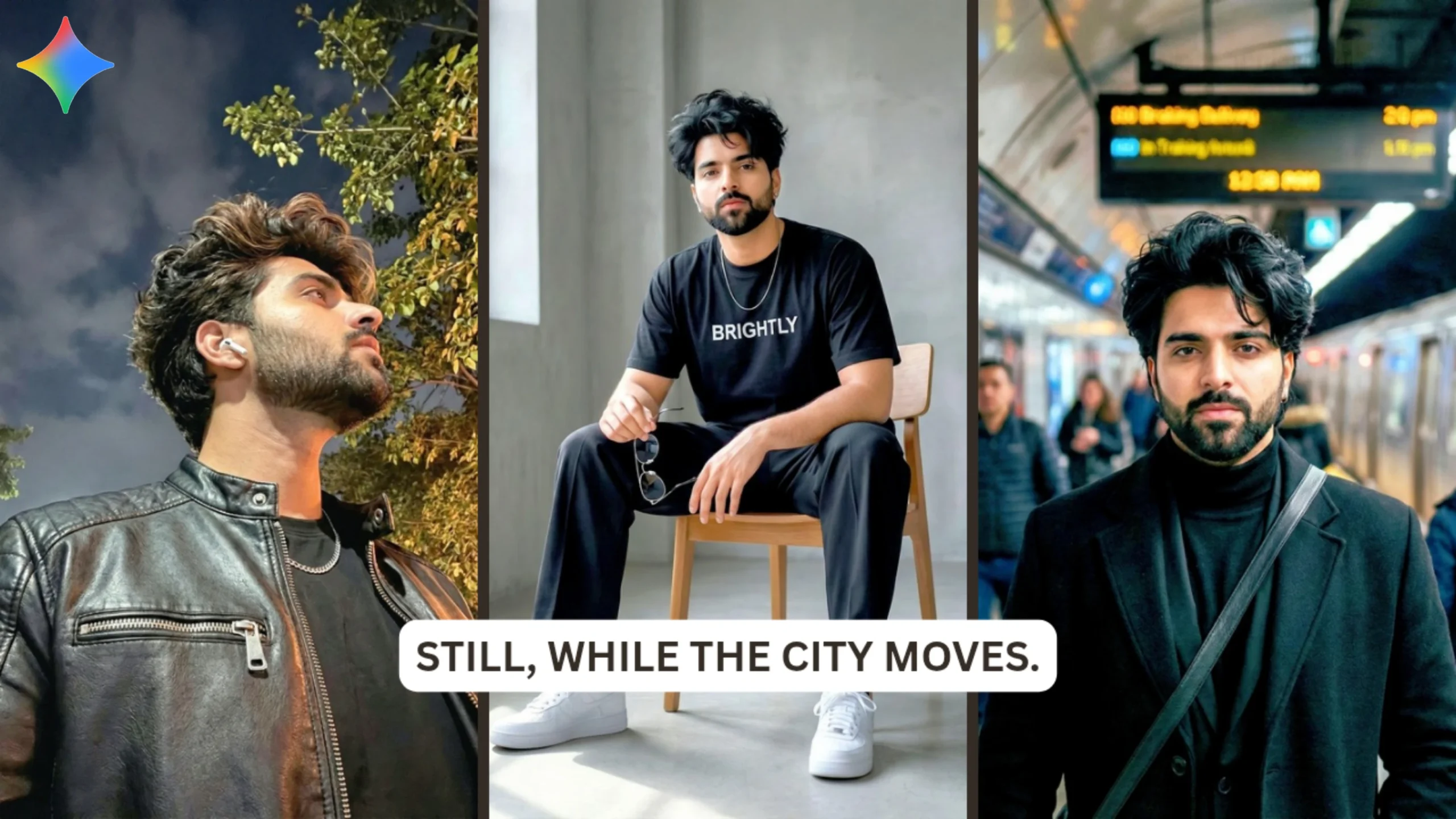
Urban portrait photography has a strange power when it’s done right. Not because of sharpness or resolution, but because it feels unplanned. The best images don’t scream “look at this setup.” They feel like moments you weren’t meant to interrupt.
The following three visual concepts all explore solitude, movement, and self-awareness in public spaces but each does it from a different psychological angle. Same city energy. Different inner states.
1. Looking Up: The Quiet Defiance of the Street
This first scene doesn’t feel staged at all. It feels caught.
The low-angle perspective immediately shifts the power dynamic. We’re not observing the subject on equal ground we’re below him, watching as he looks past us, not toward us. That upward gaze matters. It suggests thought, distraction, maybe even resistance. He’s present in the city, but not participating in it.
The leather biker jacket does heavy narrative lifting here. It’s detailed, worn-in, functional not decorative. The open zip, black t-shirt, and exposed silver chain introduce vulnerability without trying to make it sentimental. Even the white earbud plays a role: he’s listening to something private while standing in a public space.
What sells the realism is the background. Tree branches, green leaves, imperfect street lighting. Nothing dramatic. Nothing clean. That’s what gives the image its credibility. It feels like a moment that existed before the camera arrived.
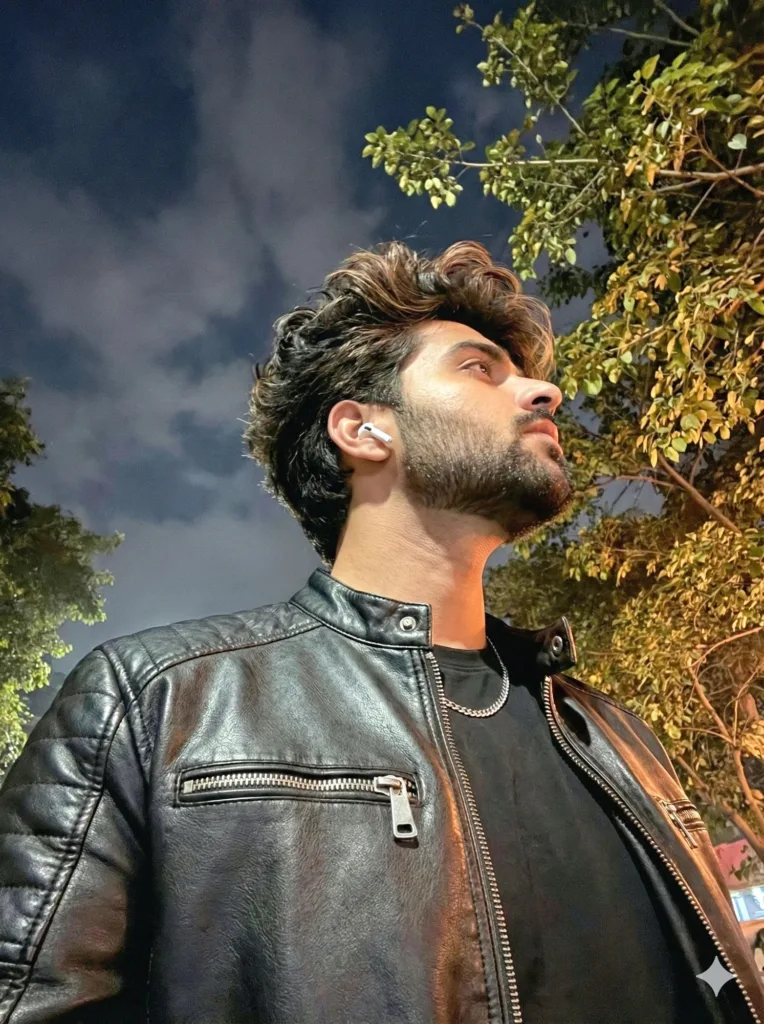
A candid, low-angle night shot of the same man from the reference image, captured in profile, looking upward away from the camera.
Pose & Angle: Low-angle profile view, natural candid framing, upward gaze.
Face: Exactly identical to the reference image (no changes to facial structure).
Natural skin texture only.
Hair: Same hairline and hair structure as the reference image, messy volumized hair with subtle light highlights.
Accessories: White wireless earbud visible in one ear. Silver necklace visible.
Outfit: Dark leather biker jacket with rich realistic detail — mandarin (stand-up) collar, horizontal zippered chest pocket with a prominent silver metal pull, textured quilted stitching across shoulders and upper arms. Jacket open, revealing a black t-shirt underneath.
Environment: Dark night sky background with tree branches and green leaves softly illuminated by ambient street lighting.
Lighting & Mood: Natural urban night lighting, raw and spontaneous feel, subtle highlights and shadows, cinematic realism.
Style: Urban candid photography, moody, realistic, unposed atmosphere.
Quality: High-resolution, sharp focus, realistic textures, cinematic night photography.
Negative Prompt:
different face, altered identity, beautified face, model face,
face swap, AI face drift, exaggerated jawline, redesigned profile,
blurry, distorted face, low quality, watermark, extra fingers
2. Stillness in Motion: Solitude on a Crowded Platform
This second portrait is quieter, but more controlled.
Here, the subject faces the camera directly, centered, composed. The subway station is busy trains, commuters, glowing signs but none of that touches him. The shallow depth of field isolates his inner world from the external chaos. This isn’t loneliness. It’s chosen distance.
The all-black outfit reinforces restraint. Wool overcoat, tailored vest, fitted turtleneck everything structured, intentional, clean. Even the minimalist earring feels deliberate rather than expressive. This is someone who’s learned how to exist invisibly in public.
Lighting does the emotional work here. Cool ambient tones dominate, but the subtle warm highlights on the face keep him from feeling cold or unreachable. The result is introspection without sadness. A pause between destinations.
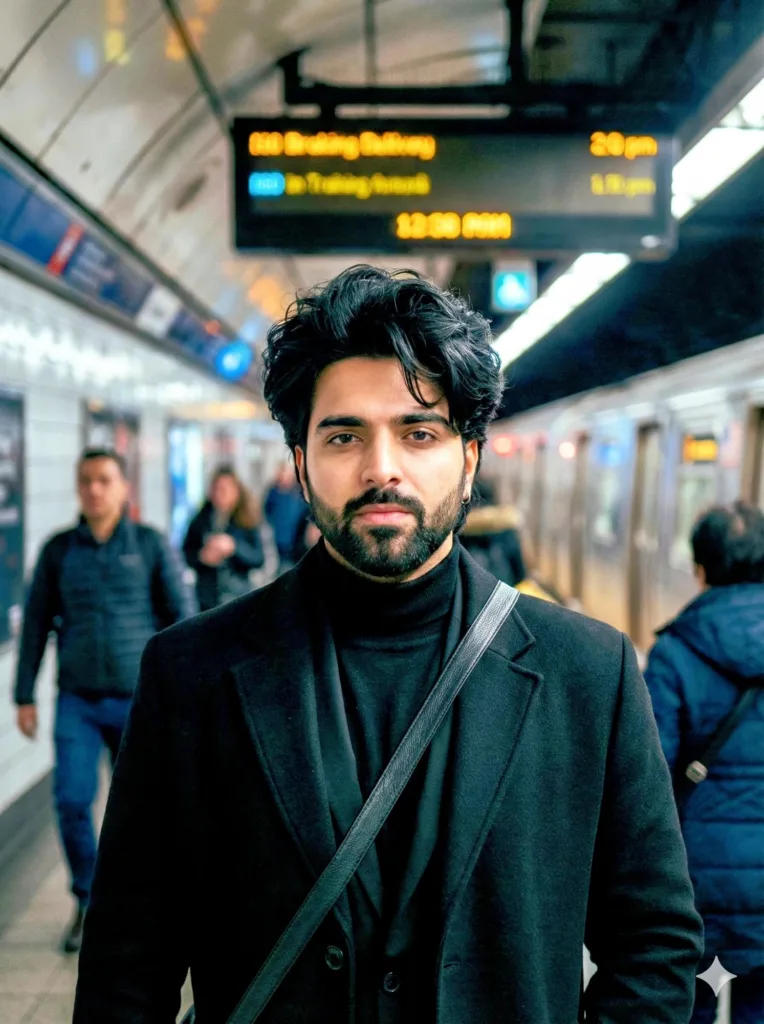
Ultra-realistic cinematic portrait of the same man from the reference image standing inside an underground subway station.
He is centered in the frame, facing forward with a calm, serious, slightly introspective expression.
Face: exactly identical to the reference image (no changes to facial structure or proportions).
Natural skin texture only.
Hair: exact same hairline and hair structure as the reference image, messy volumized jet black hair, medium-length layered curtain style, slightly tousled with natural volume.
Outfit: Elegant all-black urban style — black wool overcoat with structured shoulders, black tailored vest underneath, black fitted turtleneck sweater catching subtle light. Small minimalist earring on one ear. Black leather shoulder bag strap visible across shoulder and chest.
Environment: Underground subway platform with trains stopped on both sides. Commuters standing and walking behind him. Tiled walls, metallic train surfaces, LED destination signs glowing in warm yellow and cool blue tones.
Background softly blurred with shallow depth of field, cinematic bokeh.
Lighting: Soft cinematic lighting, cool ambient subway tones with gentle warm highlights on face and hair. Natural shadows.
Camera: Eye-level shot, medium close-up (chest-up), 50mm lens look, shallow depth of field.
Color grading: Cool teal and blue cinematic palette with subtle warm accents.
Mood & Style: Modern K-drama aesthetic, moody, elegant, urban solitude, cinematic realism.
Quality: Ultra-high resolution, sharp focus, subtle film grain, professional cinematic photography.
Negative Prompt:
different face, new person, altered identity, beautified face, model face,
face swap, AI face drift, plastic skin, exaggerated symmetry,
blurry, distorted face, low quality, watermark, extra fingers
3. The Same Space, A Different Moment of Thought
At first glance, this scene mirrors the previous one. Same subway. Same styling. Same cinematic language.
But psychologically, it reads differently.
Instead of quiet control, this version leans more into reflection. The expression feels less guarded, more inward. The commuters in the background don’t just blur into noise they emphasize time passing. People move. Trains arrive and leave. He stays still.
This is the difference between waiting and thinking.
The K-drama aesthetic matters here not because of trend, but because of pacing. Korean visual storytelling often lingers. It allows emotion to exist without explanation. That restraint is what makes this portrait feel human rather than performative.
It’s not about where he’s going. It’s about what he’s carrying mentally in that moment underground.

Portrait of the same man from the reference image, sitting relaxed on a minimalist wooden chair, legs crossed in a confident pose.
Black t-shirt with the text “BRIGHTLY” on the chest, loose black trousers, black socks, white sneakers.
Hair exactly as reference image.
Calm, cool, intense expression, looking directly at the camera.
Holding sunglasses in left hand, right hand resting on thigh.
Thin silver necklace, small earrings.
Minimalist industrial indoor setting.
Plain grey walls.
Large window with soft natural daylight from the side.
Korean fashion editorial style.
Clean, modern, moody, elegant.
Ultra-realistic, sharp focus, shallow depth of field, cinematic lighting, natural skin texture.
Negative Prompt:
different person, changed face, beautified face, model face, face swap,
AI face drift, altered identity, plastic skin,
blurry, distorted face, low quality, watermark, extra fingers
Conclusion: Why These Images Work
What connects all three prompts isn’t fashion, lighting, or camera specs. It’s psychological consistency.
Each image captures a man who is present but not exposed. Public spaces. Private thoughts. No forced drama. No exaggerated emotion. Just controlled distance and believable atmosphere.
That’s why these concepts feel real. They don’t try to impress. They let the viewer step in quietly and leave with their own interpretation intact.
Try Google Gemini Here:
This blog post and AI prompts were created by Shahbaz Ahmad.
Follow me on TikTok @Dudefrompak for more ready-to-use prompts.

📢 Join Our WhatsApp Channel
Get daily AI photo editing prompts, tools, and tips directly on your phone.
Join Now on WhatsApp 🚀
I got what you mean , thanks for putting up.